Bike · Article
How To Choose the Right Tire Pressure
Find a starting tyre pressure and learn how to adjust it for your wheels, tyres, weight and riding conditions.
By Quintana Roo · Reproduced with permission
Since I put up the Are Tubeless Tires Worth It? post, I figured it might be worth also sharing a detailed tire pressure guide to help get you rolling. Tire pressure is one of the most important things to dial in before race day, but if you�re not an experienced cyclist, you might not know where to start. Choosing the right tire pressure will improve your speed, comfort, confidence, and safety.
Tire pressure is something I see a lot of athletes get wrong. (The most common mistake I see athletes make is running their tires too firm.) To make things easy, I�ve provided Quintana Roo�s recommended tire pressure chart, but be sure to scroll down and read all of our tire pressure tips too. I�ll explain why lower pressures are actually faster, and how to experiment during training to find the perfect pressure.
Recommended Tire Pressure Charts
To get you started, these are QR�s charts for recommended tire pressures based on rim type, rider weight, and tire width. All rider weights are in pounds and tire pressures are listed in PSI. (Sorry athletes who use the metric system! For now, you�ll have to convert to kg/bar but I�ll see if I can make an updated chart.)
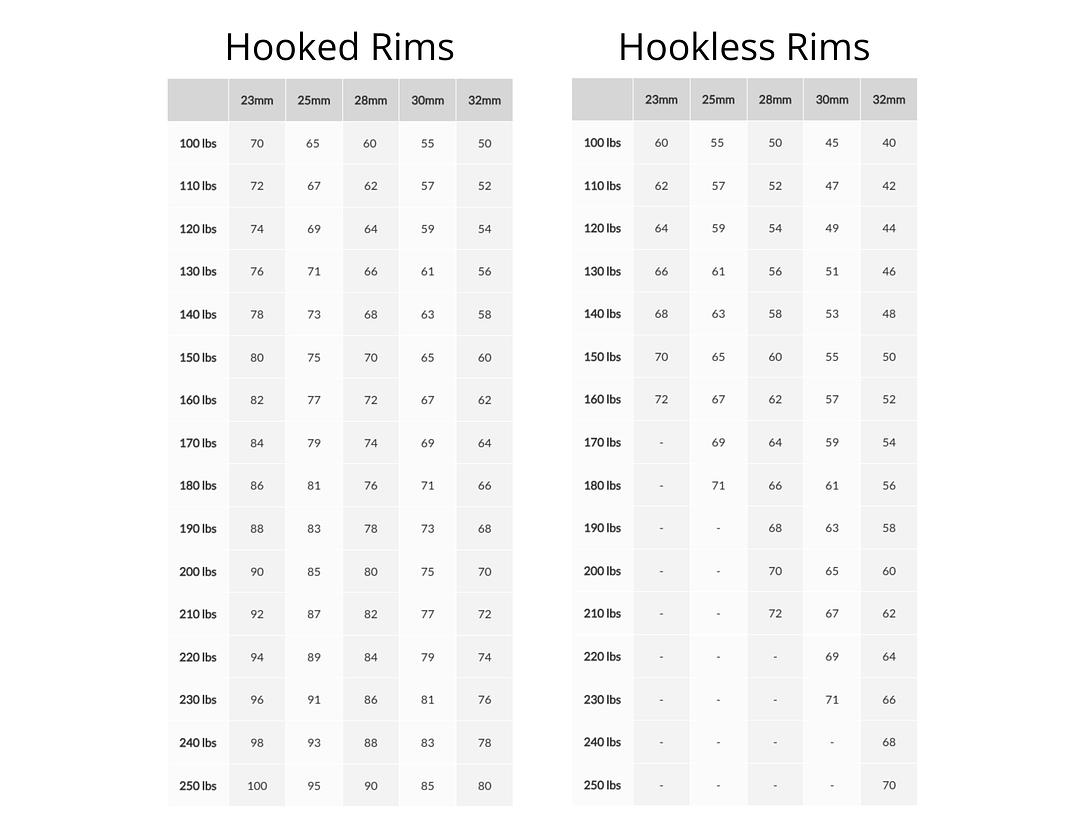
It�s important to know that these recommended tire pressures are starting points. They�ll work well for most riders in most conditions, but to truly optimize your setup for race day, it�s a good idea to test higher and lower pressures to find what works and feels best to you. The tips below will explain everything you need to know to start playing with tire pressure during training.
Also, these charts are geared toward tubeless wheels and tires but I find that my preferred tire pressures with tubes aren�t that far off. I generally add a few PSI when using tubes, just to reduce the risk of pinch flatting.
5 Key Do�s and Don�ts
1. DON�T exceed the maximum tire pressure of your rims
This is the most important thing to know when inflating your tires.
Exceeding the maximum tire pressure approved by the rim manufacturer can cause your rim or tire to fail. Maximum tire pressure can often be found on a sticker on the rim or the wheel manufacturer�s website.
General recommendations:
- Hooked tubeless rim max: 100 PSI / 6.9 BAR
- Hookless tubeless rims max: 72.5 PSI / 5 BAR
It�s important to know whether your rims are hooked or hookless. Hooked rims are more traditional. They have a hook on the rim wall that helps secure the tire bead. Hookless rims have become more common with modern tubeless wheels. Tires on hookless rims should never be inflated beyond 72.5 PSI. Exceeding this can cause tires to fail. Max pressure is generally 100 PSI for hooked rims, but some brands, like HED, recommend an 80 PSI max, so always be sure to check with the wheel manufacturer.
If you look at the tubeless-ready wheel options offered by Quintana Roo, wheels from Shimano, DT Swiss, and HED are generally hooked. Wheels from Zipp and ENVE are generally hookless. If you need clarification on whether your wheels are hooked or hookless, consult the wheel manufacturer or our Customer Service team ↗.
2. DON�T pump your tire up to the pressure printed on the tire
Many tires have a tire pressure printed on the sidewall of the tire. This is a maximum tire pressure NOT a recommended riding pressure. When I encounter riders on rock-hard tires, it�s because they just pumped them up to this number. Ignore this number and refer to the chart!
Also, the maximum tire pressure printed on the tire can sometimes exceed the maximum tire pressure of the rim. Inflating your tires this high will also result in a very poor riding experience.
3. DO use a good tire pressure gauge
A tire pressure gauge is essential for dialing in your tire pressure. Fortunately, many modern bike pumps will come with a built-in gauge, or you can use an affordable handheld gauge.
Keep in mind that tire pressure gauges are not always accurate. I�ve seen the gauges on some cheap pumps read 10-20 PSI high or low! Digital tire pressure gauges tend to be more accurate than analog gauges. Regardless, consistency is the most important thing, so it is best to always use the same gauge so you have a consistent baseline to make tire pressure comparisons and changes.
4. DO inflate your tires/check pressures before every ride
Tires will lose air throughout the day, and if you�re using tubeless tires or latex tubes, they can lose air slightly faster than traditional clincher tires with butyl tubes. To ensure consistent performance, it�s best to inflate your tires to your desired pressure before every ride.
5. DO experiment with your tire pressures
As I said above, recommended tire pressures are just that�recommendations. It�s a good idea to experiment with higher or lower pressures to find the best fit for your terrain, riding preferences, and needs. I�ll dive into how to experiment to find your ideal tire pressure below.
How To Dial In Your Tire Pressure
The tire pressures in the above charts should provide a good starting point. From there, most riders will need to go out and test their pressures, then adjust them higher or lower to suit their local terrain and riding preferences.
As you experiment with your tire pressure, you may find that you prefer using tire pressures 5-15 PSI higher or lower than what�s recommended! For example, I have a lot of rough roads where I ride so I like using lower pressures. I run my tires about 10 PSI lower than what our chart recommends.
When experimenting with tire pressures, it�s often best to test changes in 2-3 PSI increments. Here are a few basic tips for what to look for:
Increase Your Tire Pressure If:
- Your bike bounces when pedaling or accelerating.
- Your tires feel like they squirm, fold, or lack support while braking or cornering.
- Your tires bottom out on the rim when hitting bumps, cracks, or potholes. Rim strikes can cause rim damage and punctures.
Decrease Your Tire Pressure If:
- Your bike transmits too much vibration from the road into your hands, feet, and sit bones.
- Your bike feels like it lacks traction while braking or cornering.
- Your bike feels excessively harsh when hitting bumps, cracks, or potholes.
Additional Tips
- The ideal tire pressure can also vary depending on the tire and wheel so if you change one or the other, you might need to figure out your ideal pressures again. Two things to keep in mind:
- High-performance tires with thinner, and more supple casings typically need more pressure than cheaper tires or tires with thicker, puncture-resistant casings.
- A rim with a narrower internal width typically needs more pressure than a rim with a wider internal width (wider rims provide more air volume).
- Some riders may like using 1-2 PSI less in the front tire to increase front-end comfort or traction.
Bike Tire Pressure FAQ
Aren�t higher tire pressures faster?
This is only true on perfectly smooth riding surfaces (e.g. a velodrome). Real roads are rarely perfectly smooth. They have bumps, cracks, potholes, chipseal, and other imperfections.
Many riders think higher tire pressures feel faster because firmer tires transmit more vibration, bumps, and shocks into the rider. This creates the illusion that you�re going faster. Vibration, bumps, and shocks, however, are all forms of wasted energy.
Getting bounced around isn�t fast! Smooth is fast. Lower pressures allow your tires to conform to the road surface, reducing rolling resistance and allowing more of your energy to propel you forward. Lower pressures also increase comfort, which can improve your performance in long endurance events.
I have hookless wheels and my weight & tire width require more than 72.5 PSI
If your weight and tire width combo is �off the chart� for recommended hookless tire pressures, I suggest the following solutions:
- Inflate your tires to the 72.5 PSI max and see if it works for you. There is a chance your bike will ride great at or below the max recommended tire pressures listed in the chart. The only way to know is to try it.
- Switch to a wider tire - wider tires have more air volume and will allow you to use lower tire pressures. A 250lb body builder I know uses 32mm tires for this exact reason.
- Switch to hooked rims - If you are unable to fit a wider tire or don�t feel comfortable running 72.5 PSI or less, you will need hooked rims to achieve your desired tire pressures.
What if I want to run above 100 PSI / 6.9 BAR on hooked rims -OR- I weigh over 250 lbs?
Inflating your tires above 100 PSI is NOT RECOMMENDED for ANY modern tubeless tires or wheels. I suggest testing out the maximum pressure and seeing if it works for you. If you want/need to inflate your tires above 100 PSI, we recommend using tube-type tires and wheels.